More wrong with this than right, especially in the middle, but it’s the first I’ve recorded to completion and kept in almost a year, so it’s worth putting somewhere for posterity.
Recorded Thanksgiving 2017 in Apache Junction, Arizona using an OP-1.
More wrong with this than right, especially in the middle, but it’s the first I’ve recorded to completion and kept in almost a year, so it’s worth putting somewhere for posterity.
Recorded Thanksgiving 2017 in Apache Junction, Arizona using an OP-1.
(So, yeah, last week’s promise of a post tomorrow didn’t quite pan out. Anyway, without further ado…)
Anyway, thinking of cuttlefish and perhaps octopuses dreaming of Max Cooper’s and Tom Hodge’s music makes me very, very happy.
For years I’ve been in the intermittent habit of occasionally sending coworkers interesting things on Fridays that I find on the web. It may be a paper, blog post, or newspaper story that I found particularly interesting that they might not have encountered. Often, but not always, tech related. It might be a paper on ML, a history of computing paper, a blog post on keeping organized or using agile, or something like that. More recently, I’ve added a link to a single song I’d like to share. With both of these I provide a bit of commentary — no more than a few sentences, explaining why I thought this was worth following along.
I’m going to start cross-posting the content here, because there’s never anything proprietary about it, and it occurs to me that it might be of interest to a broader audience.
One remark is in order. I make no apologies that some of what I reference is behind one paywall or another, and no, I won’t send copies of what I link if you can’t access it. I am a member of the IEEE, ACM, and ARRL in part because I value the editorial work they do in their journals and to have access to their digital libraries; the fee I pay for membership in part enables them to do the editorial work that they do. The same goes for the few online news sources I pay fees to access. In all cases, there are ways for motivated non-members to access the works these organizations provide or curate — typically there’s free access for a number of works a month, or the opportunity to buy a reprint of a particular paper at a nominal cost. If what you say really interests you, it’s worth your effort to support the sources that curate that material for you.
Look forward to the first post tomorrow!
With help from KE6AFE and WB6RJH, I recently installed a Winlink RMS Packet gateway at the home station in the hopes that having easy access to one would enable me to regularly test my portable packet station — in the past I would assemble one for a specific ARES or public service deployment with bits and pieces, test it, use it for the deployment, and then pieces would be cannibalized for other projects, or software would be reinstalled. Although the topology at the house is not ideal for providing RF coverage, I thought that it would at least be a good exercise, and once set up, I could see if it added anything to the local network.
(I’ll write more about the station configuration in a later post; for this discussion it’s enough to know that it’s connected to a Kenwood TH-D700A radio running 50W into a j-pole on top of the house, but unfortunately below the lip of the canyon we live in.)
San Lorenzo Valley is served by two digipeaters, WR6AOK-3 above the middle of the valley on 145.690, and W6JWS-3 to the northeast on 145.630. In addition, WB6RJH operates WB6RJH-10 on 145.690 above the south half of the valley, with coverage extending into parts of Santa Cruz as well as most of Bonny Doon. Although not in San Lorenzo Valley, W6SCF-10 operates on 145.630, and is accessible from W6JWS-3.
Conferring with KE6AFE, we thought the best thing for me to do was put KF6GPE-10 at my home location running on 145.630, so that’s what I did. Over the month of August, the three of us performed a number of tests at locations known to be of interest during ARES activation, with a bias on Boulder Creek locations because that’s where I live and was most curious about possible simplex paths between Boulder Creek and KF6GPE-10.
I used a Kenwood TH-D72A HT running at 5W to the low-profile magmount antenna on my mobile station for the experiments.
Results were quite good, with redundant relays available at each location. I still need to exercise the WR6AOK digipeater more in both Ben Lomond and Boulder Creek; KE6AFE and WB6RJH provided me with a KA-Node script for relaying through WR6AOK that is more reliable than using plain AX.25 digipeating, but I’ve only tested that at one location. Knowing the regions that remain to be tested it does appear that each served agency location is likely to have access to at least two packet relays through at least two different paths on two different frequencies. Unfortunately, there aren’t as many simplex paths as I would like — as I feared, KF6GPE-10 is essentially unavailable by simplex from anywhere likely to be interesting (other than my living room and Redwood Elementary), and WB6RJH is far enough to the south that simplex at low power is not an option for locations very far north of Felton.
Without further ado, here are the results.
Continue reading SLV Winlink Packet Survey
Now that I’ve been using the excellent Swiss Micros DM-41 calculator a while, there are a few things I still tend to forget that are either different than the HP-41CX, or things that are the same that I just never did often enough. The HP-41CX Quick Reference Guide (if you can find one) is really handy, and I’m lucky enough to have an original printed copy in my notebook’s pocket. But there are some specifics to the DM-41, notably the power-on key assignments, that are helpful to have handy.
And thus is born my DM-41 Quick Reference Guide, available under a Creative Commons Share Alike Attributions (CC-BY-SA) license.
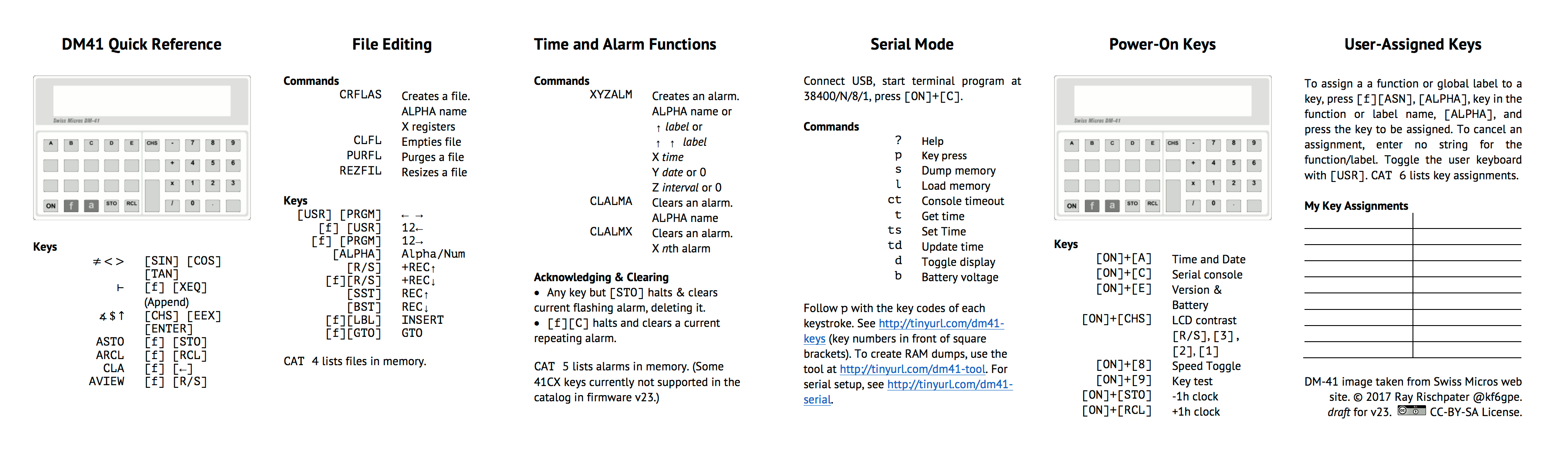
It’s formatted to print for trifold to business size, so you can slip it in the business card elastic holder of the DM-41 flip cases.
You can download and make your own from this PDF. I’ve done a limited print run on card stock; if you’re interested in getting one by sending me a SASE, do let me know by email or Twitter (@kf6gpe).
Edit 20-Aug-2017: Updated to indicate that the cards are available for an SASE.