A new toy reminding me of old experiences…

So, there are a couple of electronic music artists who release predominantly or only to cassette tape that I wanted to listen to. I have held off buying their work, because I have not owned a tape player since the early 1990’s, and haven’t really had an interest in getting one. All I really remembered was flutter, and my father attempting to fix the Sony WM-R202 I’d saved up to buy that I broke when it fell off my belt, and failing and salvaging a really strong magnet, and me being very disappointed — part of the realization that parents are not infallible that every person goes through, I suppose. When MiniDisc came out, I just gave up on tape completely for making mixes and things, and I had only dabbled in ambient sound recording when I was younger (largely discouraged by my mother, who had very poor childhood memories of growing up with my grandfather who tape-recorded everything. I thought this was an exaggeration until we started cleaning things out of his garage.)

So I decided to get a tape player. At first I figured I’d just get an inexpensive one — did the drug store still sell them? Radio Shack isn’t an option; they’re out of business. I did a bit of Googling and decided I’d get a used one instead; the general consensus online was that it would be difficult to find one new in a store, and the quality of a new one was significantly inferior to an older one of good quality — both the construction and sound quality. I did not want to obsess about sound quality, but I did not want to experience what these artists had done in a manner as poorly as my dim memories of cassette music suggested. So I went on eBay and found a Sony WM-D6C. I picked this one after reading a couple of forums; the fact that it could also record was appealing, as an adjunct to the other music stuff I’ve been doing.
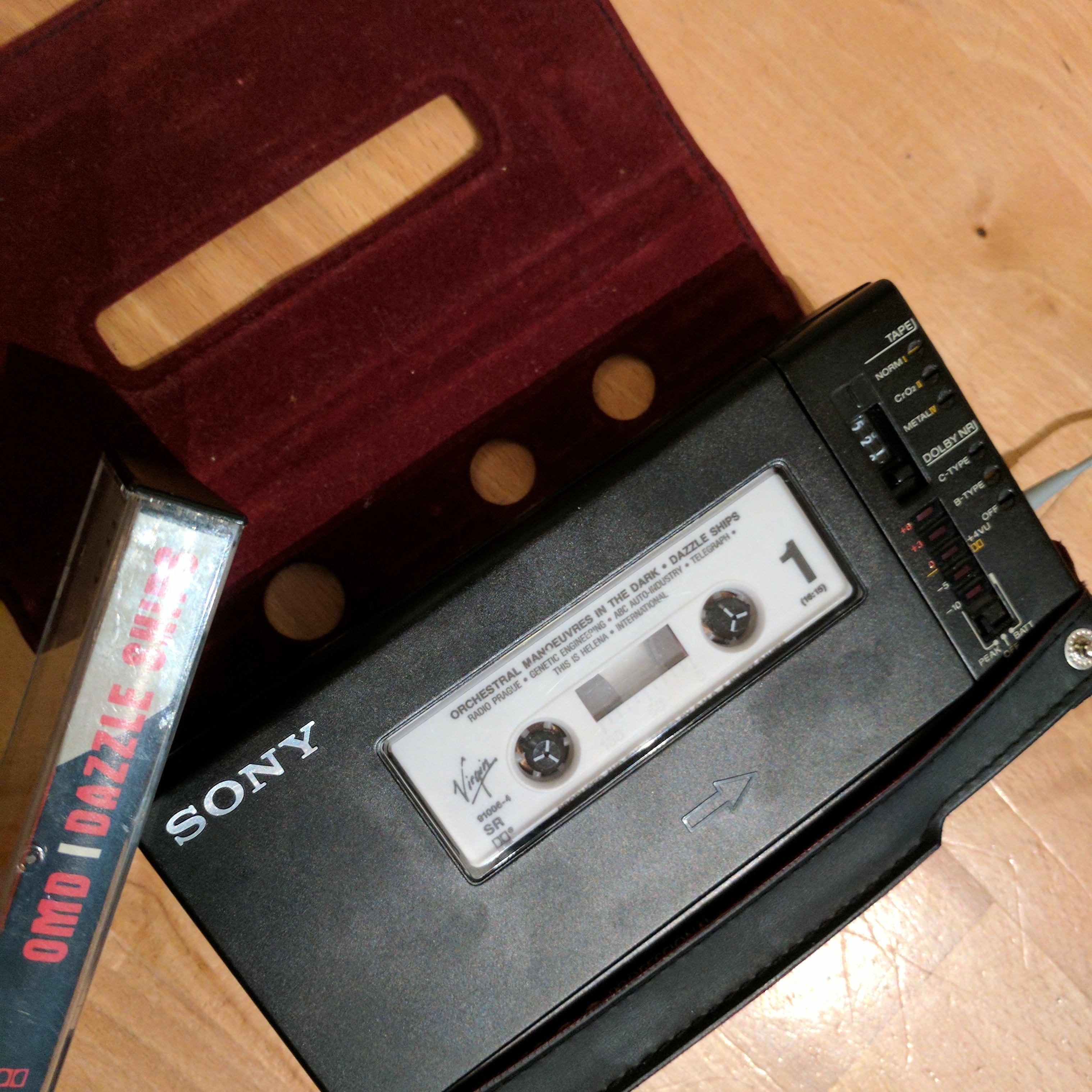
My Walkman

Continue reading A new toy reminding me of old experiences…

First short drone track from the OP-1…

I’ve had a Teenage Engineering OP-1 for about six months, and just generally plink away at it when I have a bit of free time. I love the instrument; it’s incredibly flexible, and the built in four-track and album recorder means that I can use it as a sketchpad without needing a computer running a DAW for simple things.

I’m mostly interested in assembling drone and ambient music, and it’s taken a while to figure out how to get the sounds I’d like from it.

Here’s my first attempt:

Book Review: Audio Culture

In college, I took an electronic music class, which I absolutely loved. Recently, I’ve been dabbling more with electronic music again, and I thought I should at least return to some of the fundamentals I’d learned in school.

Man, do I wish Audio Culture: Readings in Modern Music (Amazon), edited by Christoph Cox and Daniel Warner, had been out in ’89 when I took that class. It’s an awesome collection of short essays (most are 3-4 pages; a few are more) written by musicians, philosophers, and others about the experimental music and sound art scene in the last century. First published in 2004, it’s been freshly reprinted in 2013, and is as valuable now as it would have been when it first came out.

It’s divided into two parts, “Theories” and “Practices”, and in each part are sections such as:

  • Music and its others: noise, sound, and silence.
  • Modes of listening.
  • Music in the age of electronic (re)production.
  • The open work.
  • Experimental musics.
  • Improvised musics.
  • Minimalisms
  • DJ culture
  • Electronic music and electronica.

The sections on minimalism and DJ culture really knocked my socks off, with essays by Steve Reich and Laszlo Moholy-Nagy, among others.

It’s a great book to dip in and out of, and includes an extensive discography. For a lot of the music the book mentions, you can find excepts or the whole pieces on YouTube and Spotify, which really engages you with the different ideas and thoughts around sound and music.

What I found really interesting, and what took me back to my college course, is that it covers the whole century’s thinking; it’s not just about house or techno or DJing or hiphop; there’s a lot of discussion of music concrete, early electronic music, and all of the experimentation that led us to where we are today.

My only regret is not having other people to discuss the book and discography with while reading it; if I had that course to do all over again, I’d hope that this would be a textbook for the course.